
What Does a Verified Resale Ticket Mean on Ticketmaster?
by Chizuru Nobe
Update:
A Verified Resale ticket on Ticketmaster is one that Ticketmaster first sold as the event's primary ticket seller, now being resold on Ticketmaster by a fan or professional reseller. When you buy it, Ticketmaster voids the seller's ticket and reissues it in your name.
The label tells you where the ticket came from and how it reaches you. It doesn't guarantee face value or a refund. The refund and pricing rules are in Ticketmaster's Resale Purchase Policy, effective Aug. 12, 2025. It was still the current version when we checked Oct. 22, 2026.
A second label, plain "Resale," marks tickets another company sold first, and it carries different rules when an event changes.
Jump to: Refunds · Is it safe? · TicketX Buyer Guarantee
Key Takeaways
- On Ticketmaster, "Verified Resale" means Ticketmaster sold the ticket first and a fan or professional reseller is selling it again. The ticket is reissued in your name and sent to your Ticketmaster account.
- A plain "Resale" label means another ticketing company sold the ticket first. The seller delivers it through that company's app, as a PDF or by mail, and it isn't refunded if the event is postponed.
- Resellers set Verified Resale prices, which can run well above face value. When an artist uses Face Value Exchange, resale prices are locked at what the seller paid.
- How Verified Resale Works on Ticketmaster
- Verified Resale vs. Resale on Ticketmaster
- What Is the Difference Between a Standard Ticket and a Verified Resale Ticket?
- Can You Get a Refund on a Verified Resale Ticket?
- Why Are Verified Resale Tickets More Expensive?
- Is It Safe to Buy a Resale Ticket?
- How Does Verified Resale Compare With AXS Official Resale?
- Ticketmaster Resale Rules vs. the TicketX Buyer Guarantee
- Verified Resale Glossary
- Verified Resale FAQ
- Why does my Ticketmaster ticket say Verified Resale?
- Do Verified Resale tickets have a different barcode?
- Why is someone else's name on my resale ticket?
- Can you resell a Verified Resale ticket?
How Verified Resale Works on Ticketmaster
Verified Resale is Ticketmaster's in-house resale program. Ticketmaster's seller page says it's available only for events where Ticketmaster sold the original tickets and the organizer has turned resale on.
A ticket holder lists the ticket. The seller sets a price in their Ticketmaster account.
It shows up as Verified Resale. On the seat map, it appears as a pink dot with the Verified Resale logo, which shows two circling arrows. Standard tickets appear as blue dots.
You pay through Ticketmaster. Ticketmaster processes the payment and collects it for the reseller, but the sale itself is between you and the reseller (Resale Purchase Policy, Section 2).
Ticketmaster reissues the ticket. In Ticketmaster's words, "we void the old one and reissue an entirely new ticket." The new ticket is issued in your name (Section 9) and delivered to your account. Ticketmaster's help center says a resale order can take around 48 hours to show up there, or up to an hour if you buy close to the event.
The seller gets paid later. Payouts typically arrive within seven business days after the event. Sellers must keep a card on file so Ticketmaster can charge them if a buyer is refunded for a canceled or postponed event after the seller has been paid.
Verified Resale vs. Resale on Ticketmaster
Ticketmaster sorts every secondhand ticket on its site under one of two labels. Verified Resale tickets were originally sold by Ticketmaster. Resale tickets were originally sold by a third party, such as another ticketing company, and listed on Ticketmaster by resellers. The policy calls both "Secondary Tickets," but they don't behave the same way.
Verified Resale | Resale | |
|---|---|---|
Who sold it first | Ticketmaster | Another ticketing company (for example, AXS, SeatGeek or Tickets.com) |
How it reaches you | Reissued in your name and delivered to your Ticketmaster account | Seller sends it through the original company's app, as a PDF, by mail or for box-office pickup, by the date in your order confirmation |
Ticket Transfer on Ticketmaster | Available, though not for every event | Not available |
Event postponed, rescheduled or moved | Ticket stays valid; refund only if the organizer approves | Ticket stays valid; no refund |
Resell it on Ticketmaster later | Possible if the organizer allows resale | Not possible |
Source: Ticketmaster Resale Purchase Policy, Sections 9, 13 and 14; Ticketmaster Help Center.
The Resale label is the one that trips buyers up. The ticket lives in another company's system, so you may need to install that company's app and create an account before you can see it. Ticketmaster's help page on third-party resale says these sales are final "unless the event is canceled."
What Is the Difference Between a Standard Ticket and a Verified Resale Ticket?
A standard ticket is sold for the first time on behalf of the event organizer, at a face value the organizer sets. A Verified Resale ticket comes from that same original sale. Now a reseller is selling it again, at a price the reseller sets and under a different policy.
Standard ticket | Verified Resale ticket | |
|---|---|---|
Who sells it | Ticketmaster, for the event organizer | A fan or professional reseller |
Who sets the price | The event organizer sets the face value | The reseller, within any organizer limits |
Seat map | Blue dot | Pink dot with the Verified Resale logo |
Policy that applies | Standard Purchase Policy | Resale Purchase Policy |
Ticket Cash, Concert Cash, Ticketmaster gift cards | Accepted for some events | Not accepted |
Apple Pay, Google Pay, Diners Club | Accepted | Not accepted |
Exchange for other seats | Possible for many events (a fee may apply) | Not available |
Event canceled | Automatic refund once Ticketmaster receives funds from the organizer | Automatic refund once Ticketmaster receives funds from the reseller |
Event postponed | Ticket stays valid; refund only if the organizer approves | Same as a standard ticket |
Sources: Ticketmaster Standard Purchase Policy, Sections 4, 6, 15 and 17; Resale Purchase Policy, Sections 2, 4, 6, 14 and 16; Ticketmaster Help Center payment and exchange pages.
Can You Get a Refund on a Verified Resale Ticket?
Only in specific cases. Section 15 of Ticketmaster's Resale Purchase Policy says, "All sales are final." Tickets to canceled events are refunded automatically. For postponed, rescheduled and moved events, only Verified Resale tickets are refunded, and only when the organizer approves refunds for that event.
If this happens | Verified Resale | Resale |
|---|---|---|
Event canceled | Refund to your original payment method, no action needed, once Ticketmaster receives funds from the reseller | Same, but printed paper tickets must be mailed back first |
Event postponed | Ticket stays valid; refund or credit only if the organizer approves | Ticket stays valid; no refund |
Event rescheduled to a new date or time | Same as postponed | Same as postponed |
Event moved to another venue | Same as postponed | Same as postponed |
You're denied entry | No general refund right in the policy; no refund if you broke venue rules or didn't meet an entry requirement such as a minimum age | Same |
Ticket never arrives | Reissued in your name under Section 9; contact Fan Support if it doesn't show up in your account in time, and the policy warns "mistakes cannot always be rectified" | Contact Fan Support once the delivery date in your confirmation passes; no general refund clause |
Sources: Ticketmaster Resale Purchase Policy, Sections 5, 9, 10, 14, 15 and 21, effective Aug. 12, 2025; Ticketmaster Help Center.
Illinois and New York events get more. Under Section 15, you get back what you paid for a Verified Resale or Resale ticket to an event in either state if:
The event is canceled.
The ticket won't get you in, for example because it's counterfeit or the issuer canceled it for nonpayment, unless the cancellation was your fault. In New York, that includes a ticket for an event that was canceled before you bought it.
The ticket doesn't match its listing. In New York, this doesn't apply if you approved a substitute in advance.
You never received the ticket (Illinois only).
In both states, shipping and delivery fees aren't refunded for a canceled event.
What a refund covers. You get back the ticket price, extras such as parking and "(typically) service fees," but not expedited shipping, merchandise or fan club fees (Section 15). Only the original buyer can claim a refund, not someone who received the ticket by transfer (Section 13). MLB games, the Masters and the U.S. Open tennis tournament follow the organizer's own policy (Section 14).
If a postponement would leave you stuck, see whether ticket insurance is worth it.
Why Are Verified Resale Tickets More Expensive?
Because the reseller sets the price, not the artist or the venue. Ticketmaster's policy says resale tickets "are often posted at prices that are higher than their original cost." In capital letters, it warns that you may pay "substantially higher than the original face value" (Section 4).
Four things push the price up or hold it down:
Demand after a sellout. When the primary sale sells out, sellers price to demand. But Ticketmaster's help center says resale tickets are "sometimes listed above or below the original face value." The policy also notes that organizers can release more tickets after the onsale (Section 3).
Fees on top. Buyers pay service fees, and Ticketmaster says in Section 4 that some fees "may include a profit to us or the Event Organizers." Sellers pay a separate seller fee when their tickets sell. Our breakdown of Ticketmaster fees goes line by line.
Organizer limits. Some organizers set a minimum or maximum resale price, and listings must stay within those limits.
Face Value Exchange. When an artist turns this on, every resale ticket for the show is Verified Resale and is listed at exactly what the seller paid: face value plus fees and taxes. Ticketmaster charges no resale fees on these tickets. An info box on the event page tells you the show is using Face Value Exchange.
Is It Safe to Buy a Resale Ticket?
Yes, with limits. Verified Resale tickets on Ticketmaster are legit. Ticketmaster sold them in the original sale. When you buy, it voids the seller's ticket and issues a new one to you, so you aren't relying on a screenshot or a forwarded PDF. A plain Resale ticket carries one extra risk because you depend on the seller to transfer it to you on time. Neither label determines the price or what happens to your money if the event changes.
A 2023 Ticketmaster blog post says Verified Resale "does not allow any spec ticketing, so you know the tickets you buy will get you in the door." Spec ticketing means listing seats the seller doesn't hold yet. But that's marketing, not a contract term. Your enforceable rights are in the Resale Purchase Policy, and they're narrower. Outside Illinois and New York, the policy doesn't spell out a refund if a ticket fails at the gate. Outside Illinois, it doesn't spell one out if a ticket never arrives.
A few checks before you pay:
Confirm the listing says Verified Resale, not just Resale.
On Resale listings, read the delivery method and the date your tickets should arrive.
Pay only inside Ticketmaster's checkout. Ticketmaster says it will never ask you to pay with a third-party gift card.
Don't post your ticket or barcode online. The policy says Ticketmaster isn't liable if you're refused entry because someone copied your ticket (Section 19).
For broader warning signs, see how to spot fake concert tickets.
How Does Verified Resale Compare With AXS Official Resale?
AXS, another primary ticketing company, runs a similar program for tickets it sold first. The AXS help center says AXS Official Resale lets fans resell tickets on axs.com for select events. Those listings are labeled "Resale," and the seat map shows standard tickets in blue and resale tickets in orange. AXS says it guarantees every Official Resale ticket is valid. AXS Marketplace is a separate service: resale inventory from a third-party provider with its own refund policies and guarantee.
Other resale marketplaces use their own wording and rely on buyer guarantees, each with its own exclusions. On those sites, your protection comes from the platform's terms rather than the word "verified." Our StubHub vs. Ticketmaster comparison shows how Ticketmaster stacks up against one of them.
Ticketmaster Resale Rules vs. the TicketX Buyer Guarantee
TicketX is a resale marketplace, and its listings are not Ticketmaster Verified Resale. Your protection on TicketX comes from the TicketX Buyer Guarantee, which covers tickets that are fake or invalid or don't arrive in time, and events that are canceled and not rescheduled. Depending on the case, TicketX sends replacement tickets or refunds you. Prices on TicketX come with no hidden fees.
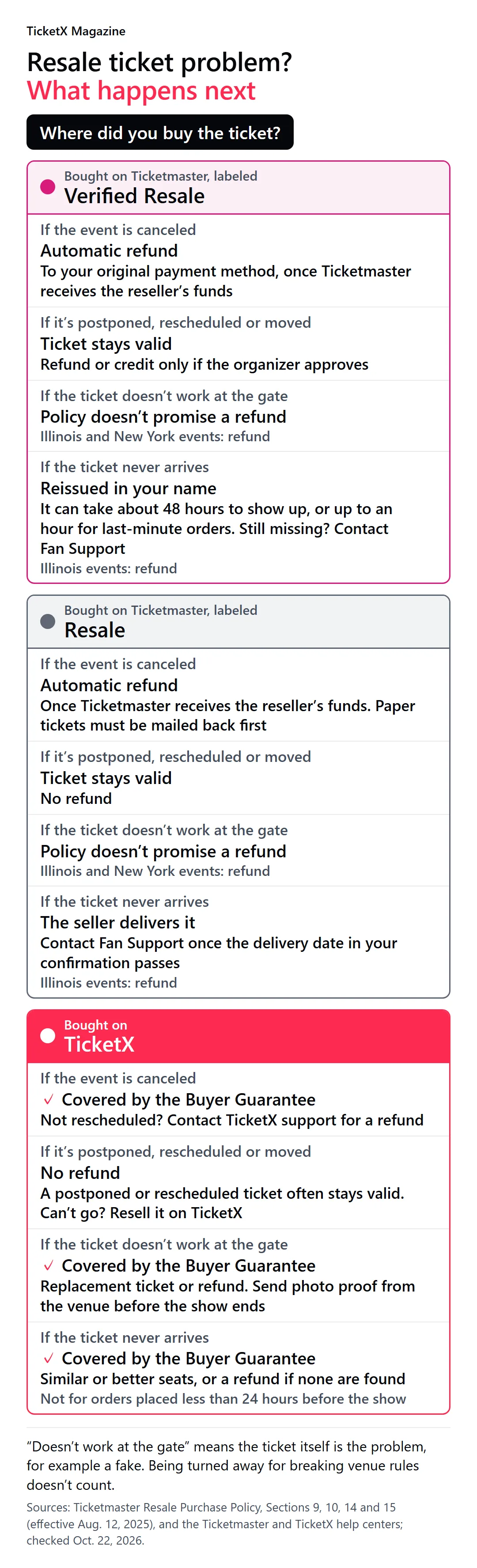
The biggest gap is at the gate. Outside Illinois and New York, Ticketmaster's policy doesn't promise a refund for a ticket that doesn't work at the gate. The TicketX Buyer Guarantee covers that case if you send photo proof from the venue before the show ends.
Neither company refunds tickets to a postponed event by default. Ticketmaster refunds Verified Resale tickets only if the organizer approves. TicketX's help center says tickets often stay valid for the new date, and you can resell yours if you can't go. TicketX's late-delivery coverage doesn't apply to orders placed less than 24 hours before the show.
Sources: Ticketmaster Resale Purchase Policy, Sections 9, 10, 14 and 15 (effective Aug. 12, 2025); Ticketmaster Help Center; TicketX help center articles on canceled events, postponed events, invalid tickets and late delivery.
For more on how TicketX handles orders, see Is TicketX legit?
Verified Resale Glossary
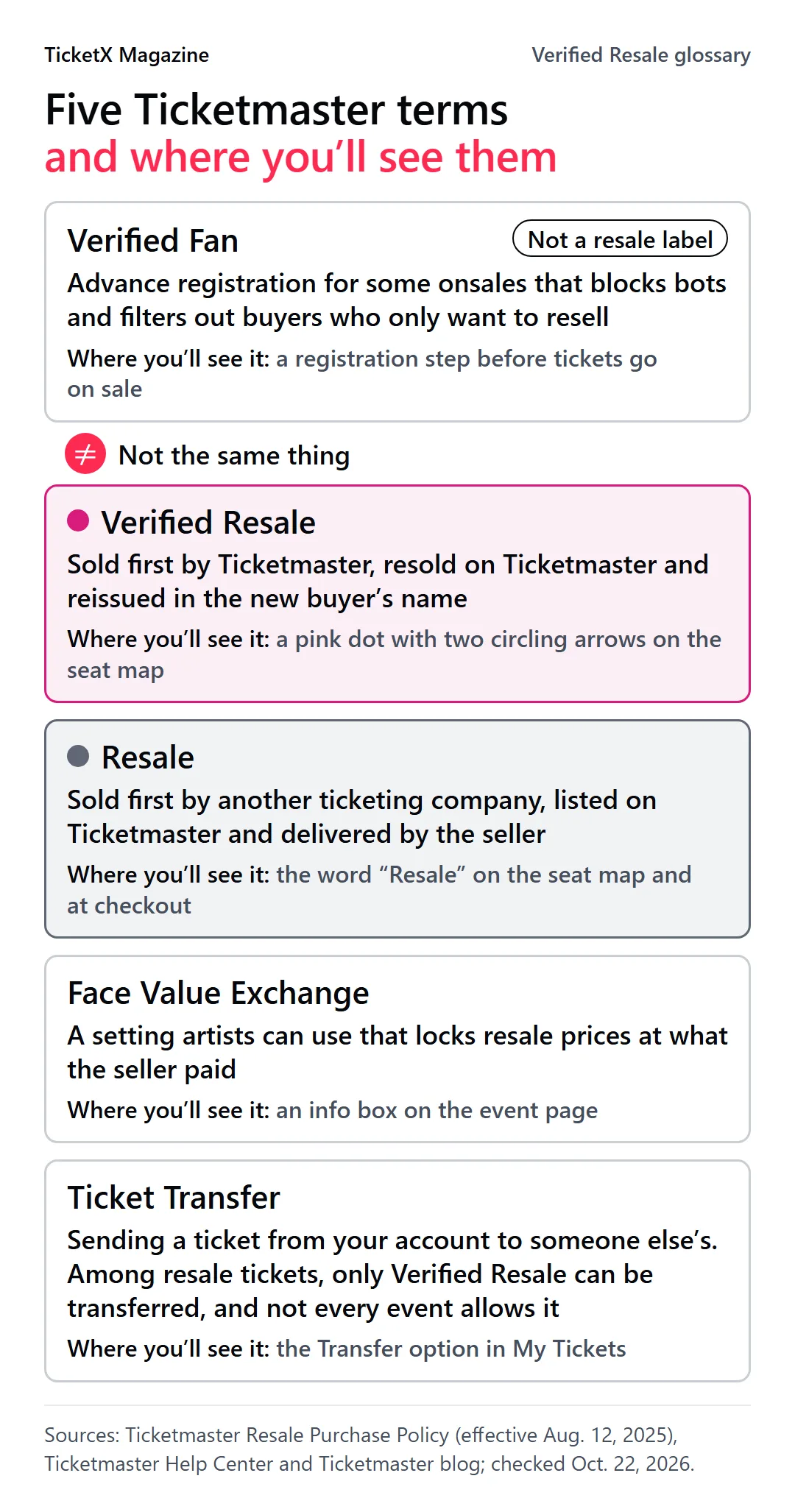
Verified Fan sounds like Verified Resale but has nothing to do with resale labels. It's Ticketmaster's advance registration for some onsales, used to block bots and filter out buyers who only want to resell.
Verified Resale FAQ
Why does my Ticketmaster ticket say Verified Resale?
Because you bought it from a fan or reseller on Ticketmaster instead of in the original onsale. The label records how the ticket reached you. It doesn't mean your order is provisional or under review. Ticketmaster voided the seller's ticket and reissued it in your name, so the ticket in your account is the valid one. In practice, the Resale Purchase Policy governs your order instead of the Standard Purchase Policy, and you can't exchange the ticket for other seats (Section 16).
Do Verified Resale tickets have a different barcode?
Yes. Ticketmaster says that when a Verified Resale ticket sells, it voids the old ticket and issues "an entirely new ticket." The seller's barcode stops working, and yours is new. That's why a screenshot from the seller won't get you in. Transfers work the same way. After several transfers, only the latest ticket is valid, and earlier barcodes are canceled (Section 13). On event day, open the ticket in your own Ticketmaster account and scan it from there.
Why is someone else's name on my resale ticket?
The name can be the original purchaser's, Ticketmaster's help center says, and you can still get in because "it's the barcode that's needed for entrance." The same page explains a second mismatch: tickets resold by other fans or third-party sellers may show the original price rather than what you paid. Neither difference stops the ticket from working. If you bought a Resale ticket that another company sold first, the ticket may also sit in that company's app instead of Ticketmaster's.
Can you resell a Verified Resale ticket?
Usually, if the event allows resale. Ticketmaster says most tickets bought on its site can be resold, but the organizer makes the final call and can turn resale off for an event or ticket type. Listing is free, and a seller fee comes out of the sale price. At Face Value Exchange shows, selling is free, and a resale ticket you bought on Ticketmaster can be listed again only at the price you paid. If you'd rather hand the ticket to a friend, Ticket Transfer works for Verified Resale tickets, though not at every event. Resale tickets that another company sold first can't be resold on Ticketmaster.
About TicketX
TicketX is America's newest secondary ticket market, which debuted in July 2023. TicketX's mission is to provide the best ticket-selling and ticket-buying experience for American users. Thanks to our solid foundation and deep secondary-market expertise, TicketX promises to bring long-term support as well as world-class customer experience to the American audience. By leveraging deep industry knowledge and a proven marketplace model, TicketX is poised to set new standards and redefine expectations in the dynamic world of resale ticket markets within America.

